Artificial intelligence is no longer a futuristic concept in design — it's a practical tool that's reshaping how spaces are planned, visualized, and delivered to clients.
Intelligent Space Planning
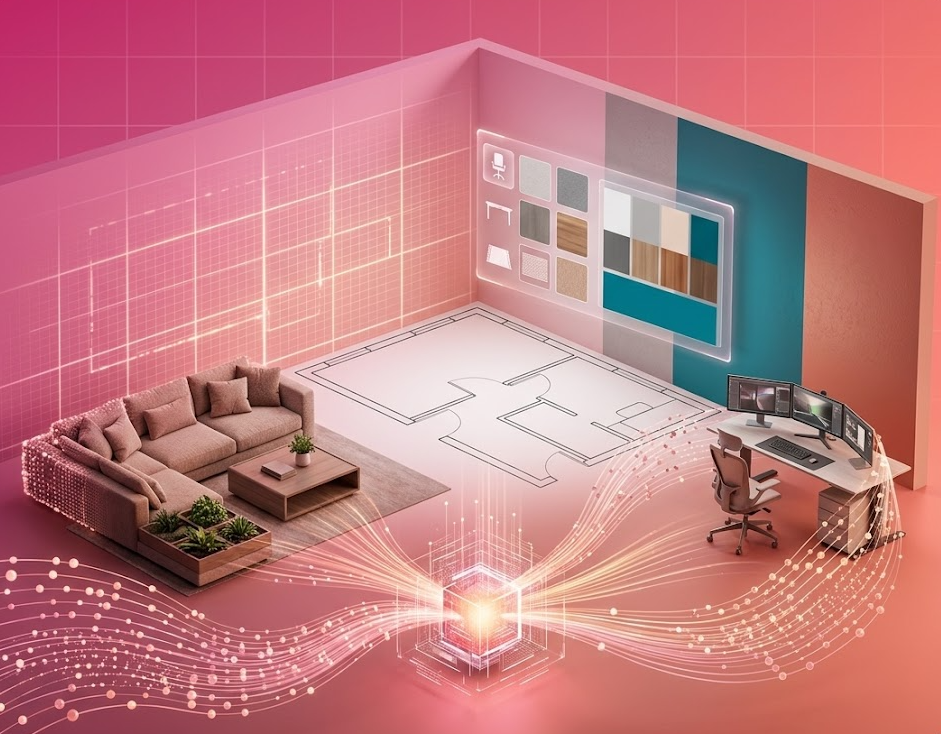
Traditional room planning requires manually placing every piece of furniture, testing different layouts, and relying on experience to determine what works. AI changes this by analyzing room dimensions, traffic patterns, and design principles to suggest optimal layouts automatically.
This doesn't replace the designer's creativity — it accelerates the starting point. Instead of spending an hour on basic placement, designers can begin with an AI-generated layout and focus their energy on the creative decisions that matter.
Style Recognition and Suggestion
AI can analyze a room's existing design language — color palette, material choices, furniture style — and suggest complementary pieces. This is particularly powerful for e-commerce integration, where AI can recommend products that fit the aesthetic of a designed space.
Generative Scene Creation
Perhaps the most exciting development is AI-powered scene generation. Rather than building a scene from scratch, designers can describe what they want — "a modern Scandinavian living room with warm lighting" — and receive a complete starting point to refine.
This isn't about generating a flat image. In Witmodel, AI-generated scenes are fully interactive 3D environments that can be edited, re-lit, and rendered from any angle.
The Human-AI Partnership
The most effective use of AI in room planning is as a creative partner, not a replacement. AI handles the tedious, time-consuming aspects of layout optimization and asset selection, while designers focus on the emotional and aesthetic qualities that make a space feel right.
This partnership leads to faster project delivery, more design options for clients, and ultimately better spaces.